It Welcome to Derry Season 1 Review: Pennywise Returned More Cruel and Terrifying Than Ever
Pennywise Was Worth the Wait
Before watching It: Welcome to Derry, my biggest question was whether Pennywise could still feel frightening.
Bill Skarsgård had already defined the character across two successful movies. His smile, voice, physical movements, and unpredictable switches between childish humor and sudden cruelty had become familiar. Bringing him back carried the risk of transforming Pennywise into a recognizable franchise mascot rather than something genuinely disturbing.
Fortunately, that did not happen.

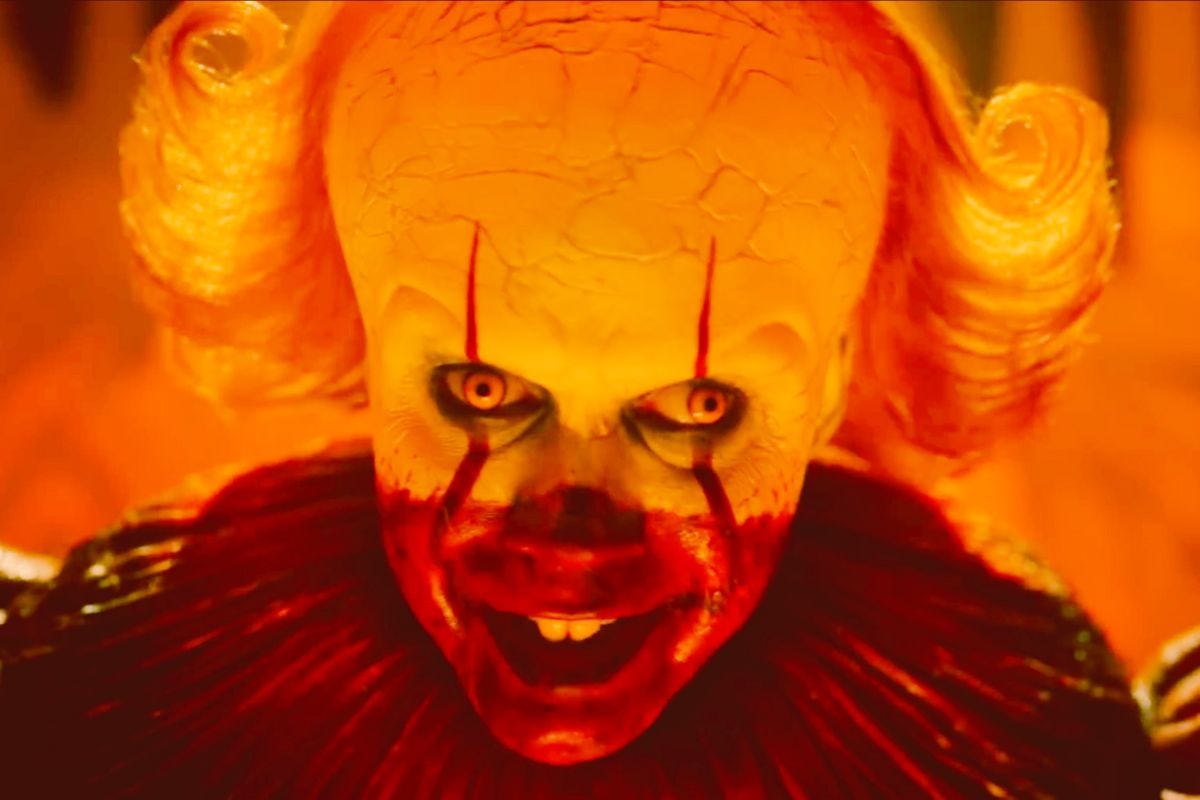
For me, Pennywise was fantastic in this series. Skarsgård returned with the confidence of someone who understands every detail of the character, but the performance did not feel like a simple repetition of what he had done before. This Pennywise seemed even more comfortable with cruelty. He did not merely frighten people because he needed to feed. He appeared to enjoy discovering exactly which emotional wound would cause the most pain.
The decision to delay his full appearance was also effective. The series allowed other manifestations of It to create fear before bringing back the familiar clown. This made Pennywise feel like one form of something much larger rather than the complete identity of the creature.
When he finally entered the story more directly, his presence mattered. The series had already created anticipation, and Skarsgård used that buildup to make every smile feel like a warning.
A Clown Without Mercy
One of the strongest elements of Welcome to Derry was the way Pennywise was portrayed as genuinely impious, cruel, and indifferent to human suffering.
The films had already established that he targeted children, but the series had more time to show how the entity studies people and turns their fears against them. It does not simply appear as a frightening monster. It understands shame, grief, guilt, prejudice, loneliness, and the desperate need to believe that someone we lost might still return.
That psychological cruelty makes Pennywise more effective than a creature that only attacks physically. He creates hope when hope will cause more damage. He allows characters to believe they have found safety before revealing that the entire situation was another trap.
The violence is sometimes graphic, but what stayed with me was the emotional cruelty surrounding it. Several scenes were tragic because the characters were not anonymous victims waiting to be eliminated. The series gave them fears, families, friendships, and unfinished lives before allowing Derry to consume them.
This created moments that were both frightening and genuinely sad. Horror becomes more powerful when the audience cares about what is being destroyed, and Welcome to Derry understood that better than many prequel productions.
Derry Became More Than Pennywise’s Hunting Ground
The original story was never only about a supernatural clown. It was also about a town that repeatedly allowed terrible things to happen.
Welcome to Derry expanded that idea successfully. Pennywise may influence the town, but human cruelty already exists before he appears. Racism, institutional violence, social indifference, military ambition, and the willingness of ordinary people to ignore suffering all become part of the environment in which It thrives.
That makes Derry feel almost like a second monster.
People disappear, children suffer, and violence occurs in public, yet the town constantly finds ways to look in another direction. This indifference is more disturbing than a simple supernatural curse because it resembles real social behavior. Evil survives not only because it is powerful, but because communities learn to normalize what should horrify them.
The Black Spot storyline was especially important in this regard. The series connected Pennywise’s supernatural influence with a tragedy created by racism and human hatred. It did not suggest that Pennywise invented those prejudices. Instead, the entity recognized them, encouraged them, and fed on the consequences.
That distinction gives the mythology more depth. Pennywise does not need to create every form of evil. Humanity frequently provides enough material on its own.
The Connection With The Shining Worked
One of the most exciting surprises was the inclusion of Dick Hallorann.
Connecting Welcome to Derry with The Shining could easily have felt like forced shared-universe marketing. Instead, the connection made sense because Hallorann already belonged to this part of Stephen King’s mythology. His psychic ability gives him a different relationship with Derry and allows the series to show how someone with the shining experiences the presence of It.
Chris Chalk also avoids simply imitating earlier versions of the character. This is a younger Hallorann who has not yet become the calm and compassionate figure audiences may remember from The Shining. He is more isolated, defensive, and willing to protect himself before helping other people.
That gives him room to develop.
The connection also makes Stephen King’s fictional world feel larger without turning the series into a collection of empty cameos. Hallorann is not present only so viewers can recognize his name. His abilities affect the story, and his experience in Derry helps explain part of the person he may eventually become.
For me, this was the right way to connect different works. The reference serves the character and narrative before serving nostalgia.

The Opening Theme Was Already Telling the Story
The opening title sequence deserves special attention because it captures the identity of the series almost perfectly.
“A Smile and a Ribbon” sounds innocent, cheerful, and tied to an idealized version of mid-century America. The images, however, gradually reveal violence, fear, and grotesque details hiding beneath that cheerful surface.
That contrast reflects Derry itself.
The town presents familiar homes, families, schools, cinemas, military authority, and community traditions. Beneath that appearance is a history filled with disappearances, racism, massacres, and generations of adults refusing to confront what is happening around them.
The opening therefore does more than create a memorable mood. It prepares the audience for a story about horror disguised as normality. The friendly song becomes unsettling because the images reveal what the smile is hiding.
I rarely feel the need to watch the full opening of every episode, but this was one of those sequences that felt connected to the experience rather than attached to it.
Did the Story Focus Too Much on Children?
Some viewers may complain that the story once again revolves heavily around children. I understand that reaction, especially for anyone who expected the series to focus mainly on Pennywise’s origins or the adult history of Derry.
However, children have always been central to It.
Pennywise feeds on fear and targets people who are vulnerable, isolated, and less likely to be believed. Children understand that something is wrong, while adults either fail to notice or actively choose not to become involved. That contrast is part of the original story’s identity.
The issue is therefore not that the series follows children. The more relevant question is whether these particular young characters are strong enough to carry the story.
For me, the results were sometimes uneven. Some characters and relationships became emotionally engaging, while others needed more time and development. The series introduced several young figures quickly, and not all of them reached the same depth.
Even so, the tragic moments worked because the show was willing to place those characters in real danger. It did not create a safe group where everyone important was automatically protected until the finale. Derry felt cruel precisely because innocence offered no guarantee of survival.
The adult storylines also prevented the season from becoming a simple repetition of the Losers’ Club. The Hanlon family, the military operation, Hallorann, and the Black Spot gave the narrative a wider historical and social perspective.
More Than an Origin Story
Before the premiere, it was easy to assume that Welcome to Derry would simply explain how Pennywise became a clown.
The finished season was more ambitious than that. It explored the relationship between It and the town, the repeating cycles of violence, the way the entity adapts to different fears, and the connections between Derry and the wider supernatural mythology of Stephen King.
I appreciated that expansion, although there is always a danger in explaining too much.
Pennywise is frightening partly because we cannot completely understand what It is. Turning every mystery into a clear timeline, rule, or origin could eventually make the creature feel smaller. Cosmic horror depends on the sense that human beings are observing only a fragment of something beyond their comprehension.
Welcome to Derry mostly maintained that balance for me. It offered more information without making Pennywise feel like an ordinary monster with a simple biography. The series showed us additional pieces, but it did not remove the feeling that something much larger still exists behind the clown.
Future seasons will need to protect that mystery. Expanding mythology should make the unknown feel larger, not reduce it to exposition.
It Did Not Disappear Beneath Alien: Earth
Welcome to Derry arrived during a strong period for horror and science-fiction television. Alien: Earth had already attracted considerable attention earlier in the same broader genre season, and both productions were competing for viewers interested in established horror franchises.
In my opinion, Welcome to Derry did not lose its identity or prominence because of that competition.
The two series offered very different experiences. Alien: Earth used corporate science fiction, synthetic bodies, alien organisms, and the fear of biological invasion. Welcome to Derry focused on supernatural evil, childhood fear, historical violence, and a town that appears to participate in its own corruption.
Rather than one production replacing the other, they demonstrated that audiences still have room for ambitious horror television when each series offers a distinct world.
Welcome to Derry also had a major advantage in Pennywise. Bill Skarsgård’s return created immediate attention, but the series did enough beyond the character to keep the conversation alive. Viewers were not discussing only the clown. They were also discussing Hallorann, the Black Spot, Derry’s history, the opening sequence, and the possibility of exploring earlier cycles.
That is a sign that the expansion worked.
Tragedy Gave the Horror Meaning
The season included several violent and shocking sequences, but its strongest moments were not effective only because of gore.
They worked because the series created emotional consequences.
Derry is filled with people carrying grief, fear, prejudice, guilt, and the memory of those who disappeared. Pennywise uses those emotions, but the resulting tragedies continue affecting the survivors long after an attack ends.
That makes the horror feel cumulative. Every generation inherits part of what happened before, even when the town tries to forget. Families lose children, communities rewrite their own history, and witnesses learn that telling the truth may bring punishment rather than help.
This is one reason I believe the series still has considerable room to grow. Each earlier period can reveal another layer of trauma beneath the version of Derry we already know. The story does not need to follow the same structure every season because each cycle occurs within a different historical context.
Pennywise remains the connecting presence, but the fears surrounding him can change with the era.
The Series Still Has Many Places to Go
The creators originally imagined a structure that moves backward through Pennywise’s cycles. After 1962, the next major destination is 1935, connected to the Bradley Gang massacre. A third chapter could travel further back to 1908 and explore the period associated with Pennywise’s earlier history.
That structure is exciting because the series does not need to force the surviving characters into increasingly artificial sequels. Each season can introduce a different generation while revealing more of Derry’s buried history.
The approach also preserves tragedy. We already know that Pennywise will eventually return because the town never truly escapes the cycle. The suspense comes from discovering how each generation confronts It, what they manage to understand, and why their victories are eventually forgotten.
A season set in 1935 could feel very different from the first. The Great Depression, organized crime, economic desperation, and public violence would create new fears for Pennywise to exploit. Going further back to 1908 could move the story closer to the origins of the clown identity without necessarily explaining the entire cosmic entity.
There is enough material here for the series to become more than an extended prequel. It could become an anthology about how evil changes its appearance while human societies repeat many of the same mistakes.
A Strong Return to Derry
Overall, I enjoyed It: Welcome to Derry a lot.
Bill Skarsgård was once again extraordinary as Pennywise, and the series allowed him to portray the character as especially merciless and cruel. The new mythology expanded the universe without completely removing its mystery, while the connection with The Shining made Stephen King’s wider world feel naturally connected.
The season had tragic and emotional moments, a memorable opening sequence, and enough visual ambition to stand beside the recent films. Not every storyline was equally strong, and some of the younger characters could have used greater depth, but the overall experience worked for me.
Most importantly, the series justified its existence.
It did not feel like a prequel created only because the movies were successful. It found stories inside Derry that the films did not have time to explore, and it showed that Pennywise’s history is inseparable from the history of the town itself.
The first season gave us more answers, but it also opened new questions. That is exactly why I want the series to continue.
Derry still has many secrets.
And Pennywise has had many faces.
Did you enjoy It: Welcome to Derry?
MARKED AS: Tv Show
COMMENTS
Want to join the conversation? Log in to leave a comment.