Planet of the Apes: A visually rich world with narrative gaps
Burton’s take on Planet of the Apes was, first and foremost, a visual spectacle. The makeup, set design, and tone had the director’s signature all over them — strange, eerie, and theatrical. From the primal-looking cities to the richly detailed simian armor, the film captured a haunting aesthetic of a civilization that felt both alien and ancient.
But despite this artistic strength, the story lacked the philosophical depth of earlier installments. The social critique and allegorical tension that made the 1968 classic a landmark in cinema felt diluted here, replaced with a more action-driven plot. Still, many viewers found themselves intrigued, especially by what came in the final minutes.
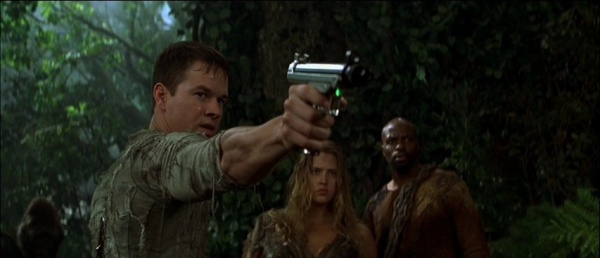
A twist ending that begged for more
Unlike the original’s iconic reveal of the Statue of Liberty, Burton’s film ends with Leo Davidson (Wahlberg) escaping the apes’ planet in a ship, only to crash-land back on Earth — or what appears to be Earth. He quickly discovers a shocking sight: the Lincoln Memorial has been replaced by a statue of General Thade, and the world is now ruled by apes.
The implication? Either time travel broke the timeline entirely, or Thade found a way to Earth before Leo. The ambiguity was intentional — Burton later admitted he wanted to leave viewers guessing. And they did. For years. Because a sequel never came.
Why didn’t the sequel happen?
Despite earning over $360 million worldwide, the film received mixed reviews. Critics cited weak dialogue, shallow character arcs, and a muddled message. Tim Burton himself declared he’d never return for a sequel, calling the production experience “horrible” in interviews. That lack of creative continuity, combined with audience ambivalence, shelved any continuation plans.
Instead, 20th Century Fox (now Disney) decided to reboot the franchise a decade later — and quite successfully. Beginning with Rise of the Planet of the Apes (2011), the new trilogy was more grounded, emotional, and narratively coherent. That timeline continued through War for the Planet of the Apes and most recently, Kingdom of the Planet of the Apes (2024), which launched a new generation of apes and has a sequel already in development for 2027.
Could the 2001 timeline return in another form?
Even if a direct sequel with Mark Wahlberg is unlikely, the 2001 timeline remains a fascinating narrative thread. Today’s entertainment landscape embraces alternate realities, and with the rise of streaming platforms, comics, and animation, it wouldn’t be far-fetched to see that storyline revived.
A limited series exploring Leo’s fate, a graphic novel tracing General Thade’s rise, or even a crossover multiverse event could bring new life to the unresolved story. Especially now, when the Planet of the Apes franchise is active again and gaining younger audiences.
Recent developments in the franchise
As of 2024, the franchise is far from dormant. Kingdom of the Planet of the Apes was released in May and kicked off a new trilogy that explores the post-Caesar world of evolving ape civilizations. Reviews so far have praised its blend of legacy themes and fresh characters. Director Wes Ball has already confirmed that the second part of this new arc is in the works.
This resurgence shows that Apes remains a flexible, evolving universe. And while the 2001 version may feel like a creative outlier, it could still be mined for new content — especially with audiences now more open to nonlinear storytelling.
Who is this film still for?
The 2001 version still resonates with fans of bold aesthetics, ambiguous endings, and sci-fi with a flair for the theatrical. If you appreciate Tim Burton’s visual language, or enjoy stories that leave you asking "what just happened?" — this film is worth revisiting. And if you’re a fan of unresolved plotlines that inspire theories years later, there’s a certain charm in its mystery.
Do you think the twisted ending of Planet of the Apes (2001) deserves to be revisited in another medium?
MARKED AS: Movie

COMMENTS